T0 focus and late sown crops
- Managing late sown crops – later drilling does not necessarily mean low yield potential
- T0 focus on yellow rust and mildew this year
- The loss of CTL from our programs will have a big impact on Septoria control
- Nitrate leaching is likely to have been significant with recent weather events
- Correct leaf emergence ID will be crucial at the T1 timing
- Using the strongest chemistry at the correct dose is crucial for both resistance management and to maximise economic return
Managing late sown crops
The temptation following the unique 2020 season is to write off many later sown crops as having low potential. However, this is a self-fulfilling prophecy – crops deemed low potential and treated accordingly will not achieve their potential. If these crops are managed well, there is no reason why they should not deliver reasonably – maybe not to their full yield potential that would have been achievable from being sown in October, but certainly combined with a buoyant grain price, returns per hectare could well be similar.
Vigilance and attention to detail this spring will be crucial, for both disease control and wider inputs. The wetter than usual winter and continued rainfall recently will have increased the risk of nutrient leaching for example, particularly nitrates. Coupled with the high levels of nitrogen likely present in residues of lower yielding 2020 crops, appropriate SNS quantification as we approach T0 timing will be crucial.
End of tillering/GS30 T0
In many cases a T0 will only be technically justified if yellow rust and/or mildew are present. With the loss of CTL, this timing should be focussed around a rust active triazole for early eradication of yellow rust in high risk scenarios. It is also important to ensure the crop has an adequate supply of nitrogen, as well as appropriate PGR use to maintain tillers.
GS 31-GS32 T1
Later drilled cereals or those held back by recent weather will move through growth stages more quickly than usual. Therefore, as we approach the traditional T1 timing, the main focus will be accurate growth stage assessment. More backward crops will have produced far fewer leaves over winter and may visually look sparse. However, crop development is largely driven by day length (modified to some extent by temperature), and so stem extension and final leaf three emergence can occur in deceptively small plants. Careful dissection is required to determine which leaf layer has emerged in mid-April – reliance on nodes can be deceptive. Final leaf three can emerge at GS31 (rather than the normal GS32). This can have important consequences for fungicide timing to ensure adequate protection of yield influencing leaf 3, and PGR applications where label growth stage restrictions may affect applications.
GS 39 T2
There is no reason to believe that by this time that the crop’s developmental stage will be far off normal, and that the flag leaf will emerge around the same time. The disease epidemic may be slightly delayed, but history tells us that Septoria continues to be the main focus regardless of season.
Yellow rust remains a key focus at the T0 timing
BASF CuraCrop monitoring showed that approximately 25% of crops nationally had some degree of yellow rust DNA in the perceived high-pressure year of 2020, although this was only half of the level of Septoria DNA infection in the low pressure years of 2018 and 2019.
Yellow rust epidemics are generally associated with new race emergence, with over-wintered infections producing disease foci by the spring. The latest UKCPVS results will be published in March and given the fluid nature of varietal resistance and the continued challenge of knowing exactly when adult plant resistance will kick in, it is crucial to keep active yellow rust out of crops at the earliest opportunity.
Whilst frost is known to kill sporulating mycelium, which will be of some comfort given the recent cold weather experienced nationally, early eradication based around a T0 application of tebuconazole should be considered in high risk scenarios. Later in the program, Xemium®, Revysol® and F 500® all have activity on yellow rust at different stages of the lifecycle and should be considered core components of a disease control strategy.
Strong yellow rust activity in a high pressure scenario, on the leaves to which chemistry was applied. Early control prolonged green leaf area and built yield:
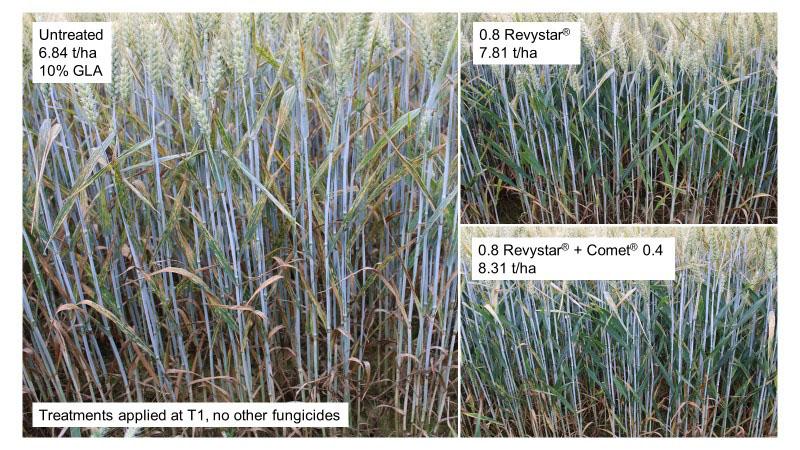
RGT Skyfall in Herefordshire (Leominster) – Photographs taken on 29/06/2020. Single application only leaf 3 at the T1 timing, no other fungicides applied.
Septoria remains public enemy number one
With the withdrawal of chlorothalonil (CTL) on 20 May 2020, concern over the protection of other modes of action (MoAs) is becoming a major talking point. CTL provided a strong level of Septoria activity as a standalone active, and its support to conventional chemistry in terms of both Septoria control and contribution to outright yield should not be underestimated.
2021 is the first year of on-farm applications without CTL, and it is reassuring that Revysol® in combinations with Xemium® has demonstrated standout efficacy across different years and disease pressures, even against adapted strains of Septoria. The use of a remaining multi-site such as folpet can be considered particularly in high pressure scenarios at the earlier application timings, but there is a smaller benefit to Septoria efficacy as the strength of the underlying chemistry is increased.
At a recent press briefing Rebecca Joynt, ADAS research scientist, gave her independent view of Revystar®You can explore more about her thoughts on Revystar XE use across a variety of disease pressures here XE performance in 2020 trials. .
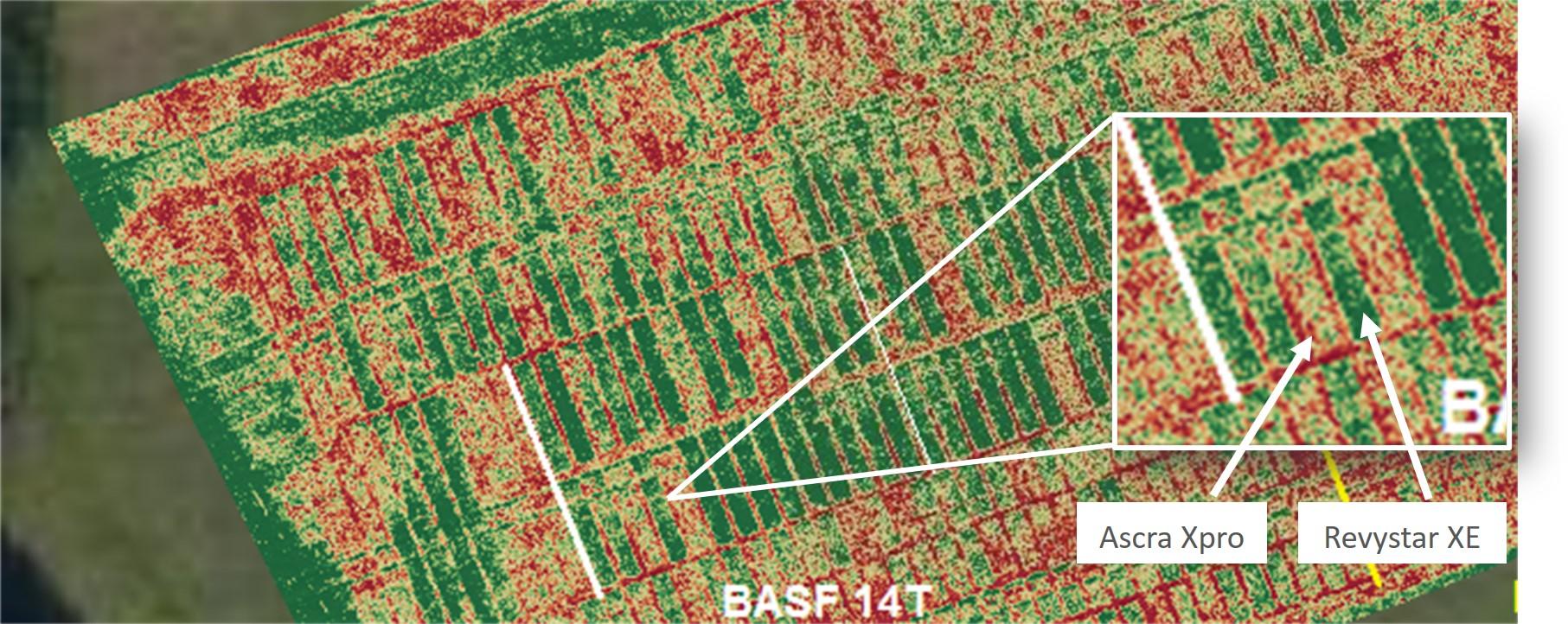
ADAS Trial commissioned by BASF. Cultivar Elation, in Pembrokeshire. Drone photo taken 17th July 2020. Pictures kindly shared by ADAS at a recent press briefing.
Revystar®agricentre.basf.co.uk. XE, Xemium®, Revysol® and F 500® are registered trademarks of BASF. Revystar® XE contains Revysol® and Xemium®. Revysol® contains mefentrifluconazole. Xemium® contains fluxapyroxad. Always read the label and product information before use. For further product information including warning phrases and symbols, you can refer to