Crystal®
Crystal® is a herbicide with residual and contact activity for the control of black-grass, annual grasses and broad leaved weeds in winter wheat and winter barley.
The best advice in autumn, where black-grass pressure is known to be high, has always been to delay drilling to provide the opportunity to generate stale seedbeds and kill off early flushes of black-grass.
This is easier said than done, especially when growers have large areas to sow. Also, the rush to drill late in the season may mean that seedbed quality is compromised in order to get seed sown. However, it is important to remember that a good seedbed will not only lead to better crop germination and establishment, but a good seedbed is also critical to optimise the efficacy and crop safety of pre-em herbicides.
A good seedbed means the following
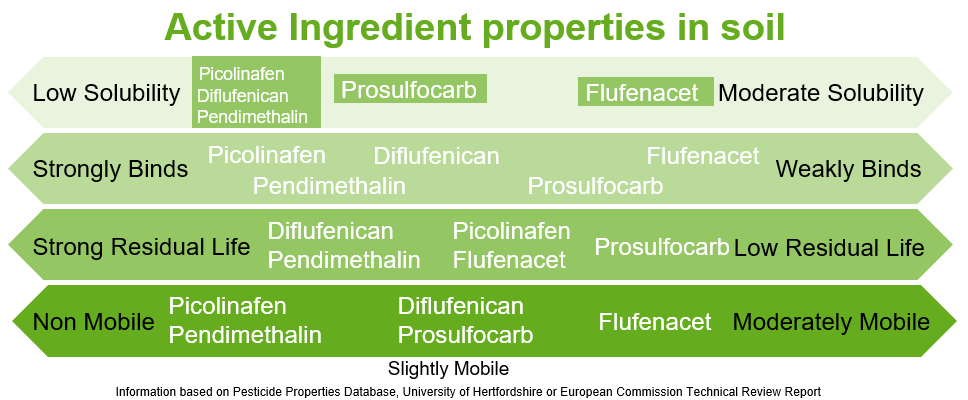
The mobility of actives within the soil is related to a range of chemical properties with solubility, adsorption and half-life being some of the more important factors. Solubility is a measure of how readily actives will dissolve in soil water - the higher the solubility, the more easily the active can be rapidly washed down and leached out of the soil profile.
Adsorption provides a measure of how strongly the actives will bind to soil - the more strongly they bind to the soil, the less active is readily available to dissolve into soil moisture and be lost through the soil profile. The half-life or residual life of an active ingredient is a measure of how quickly the active is degraded in the soil - the longer the half-life, the longer it will remain effective to control late germinating weeds.
Consideration of these chemical properties makes it easier to understand why actives such as pendimethalin, which is classed as being ‘non-mobile’, tend to ‘stay where they are sprayed’; in the top few cm of soil. They are much less likely to be leached through the soil profile after heavy rain events, in comparison to actives, such as flufenacet, which are more, mobile due to their higher water solubility and lower adsorption onto soil particles.
These chemical properties also show why the combination of pendimethalin and flufenacet in Crystal is so effective. These actives are highly complementary in terms of both their chemical properties and the weeds they control. This results in consistently high levels of efficacy across a wide range of soil conditions and weeds, since, the pendimethalin adds to the grass weed control from flufenacet as well as providing control of broad-leaved weeds.
If you have any queries or require further information, please contact your local BASF agronomy manager. Contact details can be found at www.agricentre.basf.co.uk.
Alternatively, call our technical hotline: 0845 602 2553.
Crystal® contains flufenacet and pendimethalin.
Crystal® is a registered trademark of BASF. All other products are those of other manufacturers where proprietary rights may exist. Always read the label and product information before use. For further product information including warning phrases and symbols refer to www.agricentre.basf.co.uk