Topkat®
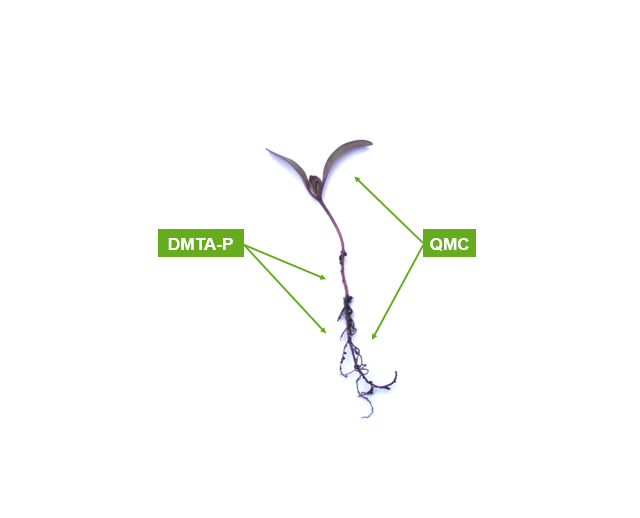
Topkat® is a new post em herbicide option for sugar beet, containing dimethenamid -p (DMTA-p) and quinmerac offering good activity on cleavers, poppy, dead nettle, speedwells and fool's parsley.
There are a number of changes to herbicide approvals this coming season. For example, Venzar is no longer approved for pre-em use and has a reduced rate for post-em use (max 0.4 l/ha, total 1.0 l/ha, with max 500 g/ha Lenacil over three years). This leaves only metamitron (with a reduced max and total dose) and ethofumesate (with a rotational limit of 1kg/ha over three years and max two applications per crop) as the two actives that are approved for use pre-em of the crop. This means that greater emphasis may have to be placed on the post-em sprays.
The loss of desmedipham after this season, is therefore likely to have the most significant impact on herbicide programmes in the future. 2020 marks the last season in which desmedipham can be used (up to end of June). This provides an opportunity for growers and advisors to evaluate alternative approaches to weed control before 2021.Topkat® / Tanaris® provides one such alternative for use in post-em herbicide mixtures;
· First approval for dimethenamid-p (DMTA-p) in sugar beet
· Co-formulation of dimethenamid-p (DMTA-p) and quinmerac
· Contact and residual activity against late weed flushes
. Post-em only with good activity on cleavers, poppy, dead nettle, speedwells, fool‘s parsley
· Flexible mixing partner to standard sugar beet herbicides e.g. mix with ethofumesate, phenmedipham or metamitron containing products to control a wide spectrum of broad-leaved weeds
· Topkat activates the partner - no need to add oil when Topkat® / Tanaris® is added to the mix
DMTA-p strengths
| Active ingredients | 333g/l dimethenamid-P + 167g/l quinmerac |
| Formulation | Suspo-emulsion (SE) |
| Activity | Contact and residual (additive effect in tank mixes) |
| Timing | Post-em from fully expanded cotyledons to before 9 true leaves (BBCH 19) |
| Max individual dose | 0.6 l/ha |
| Max total dose | 1.5 l/ha per crop per season (Split into three post-em applications) |
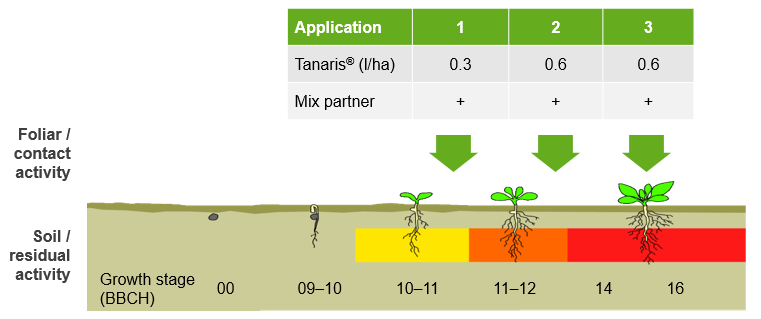
| Rate & timing recommendations | 1. 0.3 l/ha (BBCH 10-12) 2. 0.6 l/ha (BBCH 12-14) 3. 0.6 l/ha (BBCH 14-16) Minimum 7-day intervals between applications |
| Water volume | 150 – 300 l/ha (can be used at lower water volumes e.g. 100 l/ha water) |
| Soils | All soil types except sands, very light soils and soils containing >10% organic matter. Do not apply to stony soils |
| Aquatic buffer zone | LERAP 5m |
Post-em only
Water stewardship guidelines
1. Soils are moist and NOT dry, cracked or saturated
2. Field drains are NOT flowing and are unlikely to flow within 7 days of application
3. Field slope is less than 5% (a 5% gradient is 1 metre fall in 20 metres)
4. The field is NOT bordered by a watercourse
5. The field has a 5m no-spray zone or 6m grass buffer strip adjacent to water
6. The field has NOT been deep sub-soiled (below plough layer) in the preceding 6 months
7. Spring cultivations are no deeper than 20cm or previous ploughing depth, whichever is the greater
8. There is NO risk of heavy rainfall within 48 hours of application
For further information, please contact your local BASF agronomy manager. Contact details can be found at /en/® or call the BASF Technical Services Hotline on 0845 602 2553 Use plant protection products safely. Always read the label and product information before use. All other products are those of other manufacturers where proprietary rights may exist. For further product information including warning phrases and symbols refer to /en/ ® Tanaris contains dimethenamid-p and quinmerac. Betanal maxxPro contains phenmedipham, desmedipham, ethofumesate and lenacil. Venzar contains Lenacil. Tanaris is a registered trademark of BASF. Betanal MaxxPro is a registered trademark of Bayer Crop Science. Lenacil is a registered trademark of FMC.